
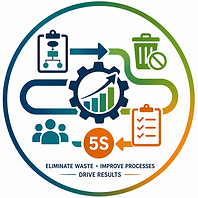
Lean Thinking, Process Improvement, and Waste Reduction
Best For
Employees, Frontline Leaders, Managers, Mid-Level Leaders, Senior Leaders, and Operational Teams
Lean Thinking and Process Improvement
Lean Thinking, Process Improvement, and Waste Reduction
Lean Thinking, Process Improvement, and Waste Reduction helps organizations identify inefficiencies, streamline workflows, reduce waste, and improve operational performance.
Many organizations lose time, money, productivity, space, and customer goodwill because work processes are unclear, inconsistent, overcomplicated, or not designed around value. Waste may appear in many forms, including unnecessary steps, rework, delays, excess inventory, poor handoffs, underused talent, limited space, scrap, lost productivity, or customer dissatisfaction.
This specialized Lean and process improvement offering gives participants practical tools for examining how work gets done, identifying where value is created or lost, and improving processes in a structured way. Depending on organizational needs, the engagement may focus on process mapping, 5S or 5C workplace organization, Kaizen events, or Six Sigma methods.
Participants leave better prepared to recognize waste, surface operational problems earlier, improve workflows, support continuous improvement, and contribute to more efficient and resilient processes that meet customer, client, operational, and organizational requirements.
Business Issue This Course Helps Solve
This course helps organizations address Lean and process improvement challenges such as:
Inefficient workflows that create delays, rework, or lost productivity
Processes that do not consistently meet operational or customer expectations
Waste related to time, motion, inventory, space, scrap, handoffs, or unnecessary complexity
Customer or client dissatisfaction caused by preventable process issues
Teams lacking a shared method for identifying and removing waste
Work areas that need stronger organization, clarity, labeling, or standardization
Operational problems related to delivery, turn time, inventory, productivity, scrap, or limited space
Process issues being discovered too late rather than surfaced and addressed early
Continuous improvement efforts that are not built into daily work
Organizations needing hands-on support from Lean / process improvement specialists
Your Instructor
Who Should Attend
This course is designed for:
Employees and individual contributors
Frontline leaders
Supervisors and managers
Mid-level leaders
Senior leaders
Operational teams
Production teams
Service and office teams
Cross-functional process improvement teams
Teams responsible for workflow, service delivery, productivity, quality, inventory, space utilization, or operational performance
Delivery Options
Lean Thinking, Process Improvement, and Waste Reduction can be customized and delivered as:
Process Mapping workshop — typically one full day / 8 hours
Lean 5S workplace organization for production environments — typically 16 to 24 hours
Lean 5C workplace organization for service or office environments — typically 16 to 24 hours
Lean Kaizen Event — typically 24 to 40 hours / 3 to 5 consecutive days
Six Sigma program — typically 80 hours delivered over 20 four-hour sessions
In-person process improvement training
Hands-on operational improvement workshop
Team-based continuous improvement session
Workflow analysis and waste reduction workshop
Production, service, office, or administrative process improvement engagement
Customized Lean / process improvement engagement led by a Lean specialist
Available in English or Spanish
Recommended Course Duration
4 to 40 Hours
Participant Outcomes
As a result of this course, participants will be better able to:
Recognize common sources of waste in workplace processes
Identify customer or client concerns that may lead to dissatisfaction
Map processes and workflows to better understand how work moves through the organization
Surface operational problems earlier and address them more effectively
Create more efficient and resilient processes
Support continuous improvement as a daily organizational and individual goal
Improve workflows related to delivery, turn time, inventory, productivity, space, scrap, or service quality
Apply Lean thinking to production, service, office, or administrative environments
Participate more effectively in process improvement, 5S / 5C, Kaizen, or Six Sigma initiatives
Connect process improvement to operational objectives and organizational priorities
Assessment / Other Details
This offering does not require a formal leadership assessment.
Because this is a more technical and operationally focused solution, the exact structure should be scoped based on the organization’s goals, process complexity, operational environment, and desired outcomes. The session may include process mapping, workflow observation, team simulation activities, waste identification, workplace organization activities, project management review, process improvement tools, or hands-on application using actual organizational data and processes.
This offering may be delivered as a targeted workshop or as a broader process improvement engagement, depending on the depth of work required.
Next Steps
Lean thinking and process improvement help organizations reduce waste, improve workflows, and build more efficient ways of working.
Contact Talent Authority to discuss how Lean Thinking, Process Improvement, and Waste Reduction can be scoped for your operational environment, process challenges, and continuous improvement goals.