
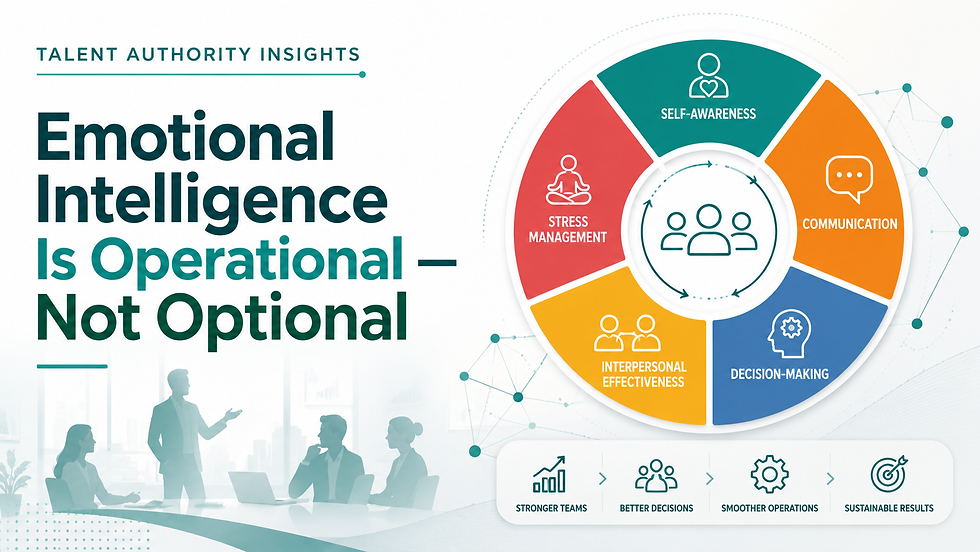
Emotional Intelligence Is Operational – Not Optional

Organizations spend significant time and money helping employees learn how to do their jobs.
They build onboarding plans.
They create technical training.
They document procedures.
They train people on systems, processes, equipment, policies, products, customers, and operational requirements.
That investment matters. Employees need the technical and operational knowledge required to perform.
But there is often a missing piece.
Many organizations focus heavily on whether employees can learn the task, process, or system, but spend far less time helping employees understand how they handle the work itself.
How do they respond to pressure?
How do they solve problems?
How do they make decisions?
How do they manage frustration?
How do they ask for help?
How do they receive feedback?
How do they handle conflict?
How do they work with people who think, communicate, or learn differently than they do?
These are not soft issues.
They are operational issues.
Emotional intelligence is not optional. It affects whether employees can apply what they learn, adapt to workplace demands, build productive relationships, handle stress, take feedback, collaborate with others, and perform consistently.
Organizations Often Train the Task but Miss the Person
Most job training is designed around the requirements of the role.
Employees are taught what to do, how to do it, when to do it, and what the expected outcome should be. That makes sense. Jobs have standards, workflows, compliance requirements, customer expectations, and performance metrics.
But people do not all absorb, process, and apply information the same way.
Some employees can hear a task explained once and perform it quickly. Others need more time, repetition, practice, visual support, examples, or coaching. Some employees process information best through discussion. Others need time to think before acting. Some need clear structure. Others need to understand the broader purpose before the steps make sense.
This is not simply a motivation issue.
People differ in how they manage cognitive load, pressure, uncertainty, feedback, ambiguity, and interpersonal demands. They differ in how they learn, how they respond when they make mistakes, how they regulate emotions, and how they interact with others while trying to perform.
When organizations ignore these differences, training can become too standardized. The content may be technically correct, but the approach may not account for how different people actually learn and apply the work.
A one-size-fits-all training model may be efficient to deliver, but it is not always effective in producing consistent performance.
The Missing Link Is Often Emotional Intelligence
Emotional intelligence helps explain how people understand themselves, relate to others, manage stress, solve problems, make decisions, express themselves, and navigate workplace demands.
In practical terms, emotional intelligence affects how employees:
Respond when work becomes difficult
Handle pressure and deadlines
Ask for clarification
Receive coaching and feedback
Manage frustration or disappointment
Collaborate with coworkers
Control impulses before reacting
Make thoughtful decisions
Communicate needs and concerns
Adapt to change
Build trust with others
Recognize how their behavior affects the team
These capabilities influence job performance every day.
A technically capable employee may still struggle if they become defensive when corrected, shut down under pressure, react impulsively, avoid asking questions, misread coworkers, or have difficulty adapting when work changes.
A leader may have strong operational knowledge but still struggle if they cannot coach effectively, regulate their own stress, communicate with empathy, manage conflict, or understand how different employees need to be developed.
This is why emotional intelligence should not be treated as a separate “nice to have” topic.
It is part of how work gets done.
Emotional Intelligence Is Operational
Organizations often think of emotional intelligence as a leadership development topic. It is certainly important for leaders, but it is not limited to leaders.
Emotional intelligence affects employees at every level because every role requires some combination of self-management, decision-making, communication, resilience, adaptability, and relationship management.
In operational environments, emotional intelligence can affect quality, safety, productivity, customer experience, teamwork, retention, and supervisor time.
For example:
An employee with stronger impulse control may be less likely to react defensively during coaching.
An employee with stronger stress tolerance may be more effective during busy periods or unexpected changes.
An employee with stronger self-awareness may better understand when they need clarification or support.
An employee with stronger empathy may work more effectively with customers, peers, and leaders.
An employee with stronger problem-solving and decision-making skills may respond better when standard procedures do not fully address the situation.
These behaviors are not separate from performance.
They shape performance.
Leaders Need Emotional Intelligence to Develop Others
Emotional intelligence is especially important for leaders because leaders are responsible for helping others perform.
A leader may understand the job well, but that does not automatically mean they know how to develop people. Teaching, coaching, correcting, motivating, and supporting employees require more than technical expertise.
Leaders need self-awareness. They need to understand how their communication style, stress response, expectations, tone, and feedback approach affect employees.
They also need social awareness. Employees do not all need the same type of direction, support, structure, encouragement, or accountability. Some need more detail. Some need more context. Some need more autonomy. Some need more check-ins. Some need direct feedback. Others need help building confidence before they can apply the feedback effectively.
When leaders understand their own emotional intelligence, they can become more effective coaches. They can better recognize how employees learn, where they may struggle, how they respond to pressure, and what kind of support may help them improve.
Without this awareness, leaders may default to a one-size-fits-all approach.
They may explain something the same way to everyone, coach every employee in the same style, or become frustrated when employees do not learn or respond the way the leader expects.
Better leader self-awareness creates better employee development.
Training Professionals Should Design for Human Complexity
Training design should also account for emotional intelligence.
If a curriculum assumes that everyone will process information the same way, respond to feedback the same way, or apply learning at the same pace, it may miss important barriers to performance.
Training professionals should consider questions such as:
How much information are employees expected to absorb at once?
Where might cognitive load become too high?
What emotional reactions might occur when employees feel uncertain or corrected?
How will learners ask questions or seek support?
How will leaders reinforce learning after training?
What self-awareness do employees need before they can apply the technical skill?
What communication or stress-management skills are needed to perform the task well?
How can training build confidence without lowering standards?
Technical training and operational training are stronger when they consider the emotional and behavioral demands of the work.
For some roles, that may mean adding coaching guides for leaders. For others, it may mean providing employees with assessment-based insight before training begins. In other cases, it may mean building in reflection, practice, feedback, peer discussion, and support for different learning styles.
The goal is not to make training easier.
The goal is to make training more effective.
Assessments Can Give Employees a Roadmap Before Training Begins
One practical way to strengthen training and development is to provide employees and leaders with emotional intelligence insight before technical, operational, or leadership training begins.
An emotional intelligence assessment can help individuals better understand how they tend to solve problems, make decisions, manage stress, control impulses, express themselves, build relationships, and demonstrate self-awareness.
This matters because employees are not just learning the task. They are learning how they approach the task.
For example, an employee may realize they tend to become overwhelmed when too much information is provided at once. Another may recognize that they hesitate to ask questions because they do not want to appear unprepared. A leader may realize they move too quickly into problem-solving without listening long enough to understand the employee’s perspective.
This type of insight gives people a practical roadmap.
They can begin to understand what they may need to adjust in order to meet the requirements of the role, work better with others, and apply training more effectively.
The assessment does not replace technical training. It strengthens the conditions for learning and application.
Emotional Intelligence Also Supports Better Hiring and Role Fit
Emotional intelligence can also be relevant before someone is hired or promoted.
Organizations often evaluate whether a candidate has the experience, education, technical skills, or operational background needed for the role. Those factors are important, but they may not reveal how the person will handle pressure, feedback, ambiguity, relationships, conflict, decision-making, or change.
For high-impact roles, especially those involving leadership, sales, customer relationships, teamwork, or fast-moving operational demands, emotional intelligence can provide useful insight into how a person may approach the realities of the job.
This does not mean emotional intelligence assessments should be used as a shortcut or as the sole basis for hiring decisions. They should be used responsibly, as part of a structured process that considers job relevance, role requirements, interview data, work history, and human judgment.
But when used appropriately, emotional intelligence and behavioral assessments can help hiring teams ask better questions, identify development needs earlier, and better understand whether a candidate is likely to thrive in the environment.
The question is not only, “Can this person do the job?”
The stronger question is, “How is this person likely to handle the conditions under which the job must be done?”
Emotional Intelligence Improves Working Relationships
One of the most important secondary benefits of emotional intelligence development is better working relationships.
When employees understand themselves and others more clearly, they are often better able to communicate, collaborate, manage conflict, and avoid unnecessary friction.
They may become more aware of how they react under pressure. They may better understand why certain coworkers frustrate them. They may become more thoughtful about how they express disagreement, receive feedback, or ask for support.
These improvements affect the workplace beyond individual performance.
Stronger emotional intelligence can:
Build trust
Improve communication
Reduce unnecessary conflict
Strengthen accountability
Improve coaching conversations
Support better teamwork
Increase resilience during change
Improve employee experience
Free leaders to focus on higher-value priorities
When employees lack these skills, leaders often spend significant time managing interpersonal friction, misunderstandings, defensiveness, conflict, or avoidable performance issues.
When emotional intelligence improves, leaders can spend more time developing people, improving performance, and addressing business priorities.
Emotional Intelligence Should Not Be Reserved for Leadership Development
Organizations sometimes treat emotional intelligence as a topic for executives or leaders.
That is too narrow.
Leaders need emotional intelligence, but so do employees, teams, high-potential talent, customer-facing employees, technical experts, project teams, and individuals in roles where collaboration, judgment, stress tolerance, and adaptability matter.
Emotional intelligence is not simply about being nice, warm, or agreeable. It is about functioning effectively in real workplace conditions.
It affects how people think, decide, communicate, adapt, respond, and relate to others.
If organizations want employees to perform at a higher level, adapt to change, build stronger relationships, handle feedback, and contribute to healthier teams, emotional intelligence should be part of the broader development strategy.
It should not be optional.
The Equation Is Incomplete
Organizations will always need technical training, operational training, compliance training, and job-specific instruction.
But those investments are incomplete if employees and leaders are not also equipped to handle the emotional, interpersonal, and decision-making demands of work.
Technical skill helps people know what to do.
Emotional intelligence helps them manage themselves and others while doing it.
Both matter.
Organizations that prioritize emotional intelligence before, during, and after job-related training can create stronger conditions for learning, application, accountability, and performance.
They can help employees understand how they approach work. They can help leaders coach more effectively. They can help training professionals design for real human complexity. They can help hiring teams evaluate role fit more thoughtfully. They can help teams build trust, communication, and resilience.
Emotional intelligence is not a nice-to-have topic.
It is operational.
And organizations that recognize that are better positioned to develop people who can not only do the job, but handle the realities of doing it well.
About Talent Authority
Talent Authority helps organizations strengthen employee and leadership effectiveness through practical development solutions, behavioral assessments, emotional intelligence assessments, coaching, hiring and selection support, team effectiveness sessions, and customized workplace training.
We help HR, talent, and business leaders connect development efforts to the real behavioral, emotional, interpersonal, and operational demands of work. Our assessment-based approach provides practical insight into how individuals solve problems, make decisions, manage stress, communicate, build relationships, respond to pressure, and adapt to workplace expectations.
Whether supporting employee development, leadership development, pre-hire insight, succession planning, team effectiveness, or technical training readiness, Talent Authority helps organizations build development strategies that reflect how people actually learn, work, and perform.
Developing Leaders. Strengthening Teams. Better Talent Decisions.


Comments